
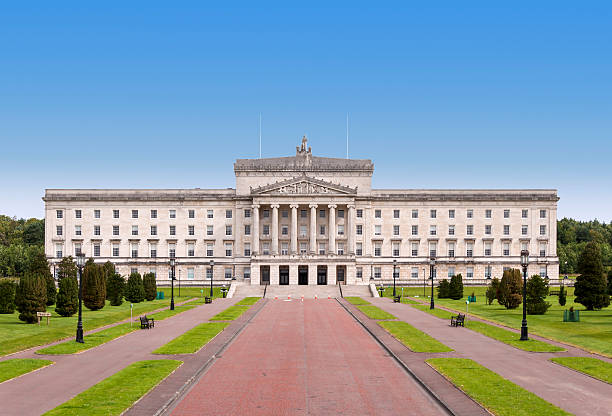
Northern Ireland Assembly and Government building in Stormont Estate in Belfast
With both an NI Assembly and a Local Government election in 2027, the campaign has already begun. One could be forgiven for thinking it’s all over bar the shouting at Stormont for this mandate, however, a few important milestones remain, and legislative developments which are important for us all.
Farming families in Northern Ireland are best served when the NI Executive and Assembly are in place, and where decisions can be made by locally elected decision makers. Nevertheless, the current mandate is going to be judged on delivery and specifically on what it has delivered for farmers. The biggest achievement was the agreement to ringfence the Sustainable Agriculture Programme budget (SAP) of over £300 million. Credit must be given to Minister Muir and the role he played in that, as well as the other Executive parties and the UFU’s own efforts. Apart from this specific achievement, the widespread feeling is that this mandate has delivered very little apart from stalemate on issues and a style of trench warfare on others, whereby UFU and wider industry have had to stand with a shield over the farming community, protecting it from many pieces of shrapnel.
Etched into the memory of every farmer in Northern Ireland was the shambolic end of the last Assembly Mandate, which resulted in the disastrous Climate Change Act (Northern Ireland) 2022. The Act was a combination of the very worst of policymaking in Northern Ireland and an episode not to be repeated. However, one must ask whether lessons have lessons be learnt? Specifically on the Climate Change Act, there is widespread private acceptance that targets are not going to be met, albeit with the political class left scratching their heads as to what happens next. On other controversial policy matters, our politicians, the elected decision makers, should pause the process until the next Assembly mandate, as opposed to rushing through ill-thought-out policy.
The prominence of Agriculture in the upcoming months will be an interesting debate to follow as the election creeps ever closer. Following the UFU vote on no confidence in DAERA, an action which shook the system. The other political parties outside of the Alliance party were deeply concerned about the direction of travel of the relationship between the department and the farming community. Some in the farming community are convinced Agriculture will be a top-tier election issue, although when issues around education, health, and lack of infrastructure arise, will farming be centre stage?
UFU have established an election committee to plan and prepare ahead of the next local government and NI Assembly Elections. This work is essential to organising political events over the next year, creating manifestos, and most importantly, lobbying the political parties to adopt policies which are in the best interests of the farming families and achieve cross-party consensus on policy matters which any future NI Executive would have to pass into law.
Finally, and most importantly, our key ask is that those parties that support productive agriculture will make a concerted effort to take on the responsibility of serving as DAERA Minister and for all three parts of the department, agriculture, the environment and rural affairs, whilst also restoring trust and confidence back into relationships. Everything else flows from this outcome.