
Livestock theft, livestock worrying, trespass and anti-social behaviour can have an impact far beyond the immediate financial loss to farm families. During Rural Crime Week, the Ulster Farmers’ Union is encouraging farmers to remain vigilant, report suspicious activity, and understand what action they can take when problems arise.
Livestock theft remains a serious threat
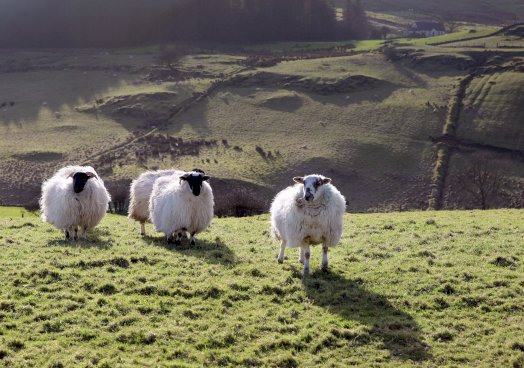
Livestock theft is far from a thing of the past. NFU Mutual’s 2026 Rural Crime Report estimates that the cost of livestock theft across the UK increased by almost 30% during 2025 to £4.5 million. It also warns that livestock theft has evolved into an increasingly organised form of crime, with dozens of sheep sometimes taken in a single incident. Northern Ireland has experienced significant incidents too, as PSNI figures released in response to an FOI request recorded individual incidents involving, among others, 169 sheep in September 2024, 116 sheep in March 2025 and 61 sheep in May 2025. The consequences are not limited to the market value of the animals, as theft can disrupt breeding programmes and leave farmers with the cost and difficulty of replacing stock. There is also the distress of not knowing what has happened to animals which have been cared for.
Farmers can take practical precautions. The PSNI recommends knowing your stock, maintaining accurate records, regularly checking grazing fields and keeping fences, hedges and gates in good repair. Livestock identification is particularly important as proof of ownership, and PSNI recommends keeping photographs or video of valuable animals with ear tags or other identification clearly visible. These measures will assist any enforcement operation.
Preventing livestock worrying
Livestock worrying remains another major concern, particularly where dogs are allowed to run uncontrolled near farm animals. The 2026 NFU Mutual report estimated that farm animals worth £1.95 million were severely injured or killed in dog attacks during 2025, a 10% increase on the previous year. Its survey of dog owners found that one in 20 admitted their dog had chased livestock, while 65% did not believe their dog was capable of harming or killing farm animals.
The message to dog owners is therefore straightforward: any dog can chase or attack livestock, regardless of breed, size or temperament. It doesn’t matter how much you ‘know your dog’, and dogs should be kept under proper control around livestock and on a lead. Farmers should regularly inspect fences and hedges and alert neighbouring farmers if loose dogs are seen near livestock.
If an attack occurs, evidence matters. Official guidance recommends taking photographs or video of the scene and injured livestock, recording ear-tag numbers and, where possible, obtaining veterinary evidence. Incidents of livestock worrying should be reported to the relevant council dog warden so that they can be investigated and properly recorded.
Trespass and aggravated trespass
Trespass is another issue regularly raised by farmers, but there can be confusion about what the law allows. Ordinary trespass onto private land is generally a civil matter. Someone walking onto farmland without permission does not automatically commit a criminal offence simply by being there.
However, aggravated trespass – a criminal offence – is different. Under the Criminal Justice and Public Order Act 1994, aggravated trespass occurs where somebody trespasses on land in the open air and intentionally intimidates, obstructs or disrupts people carrying out a lawful activity on that land or adjoining land.
In practical terms, someone simply crossing a field without permission may amount to ordinary trespass. Someone trespassing and deliberately blocking machinery to prevent lawful farm work, or intentionally intimidating a farmer to stop an activity, may potentially amount to aggravated trespass.
Other behaviour committed while trespassing may of course constitute separate criminal offences, including theft, criminal damage or threatening behaviour.
Farmers should therefore report incidents where criminal behaviour, damage, threats or deliberate disruption are involved rather than assuming that everything connected with trespass is automatically a civil matter.
Anti-social behaviour should not be dismissed
Farmers also experience a wider range of disruptive behaviour including joyriding, fly-tipping, hare coursing, damage to gates and fences and people entering land without regard for crops or livestock. The UFU believes these incidents should not simply be accepted as part of living in the countryside.
Where you see suspicious vehicles or behaviour, record as much information as it is safe to do, including the vehicle registration, make, model, colour, location and time. PSNI has repeatedly stressed that apparently insignificant sightings can help police identify wider patterns of rural offending.
Report crimes and suspicious activity to the PSNI on 101, or 999 in an emergency. Information can also be given anonymously through Crimestoppers.
Farmers should not have to accept theft, worrying or anti-social behaviour as an inevitable part of farming. The better the information available to police and other authorities, the stronger the response can be. As highlighted, some farm families have little faith that a report will lead to any action, but this merely creates a vicious circle whereby a lack of reporting means policing resources and policy attention are diverted elsewhere, leading to a lack of enforcement against rural crime and the continued prevalence of it.