
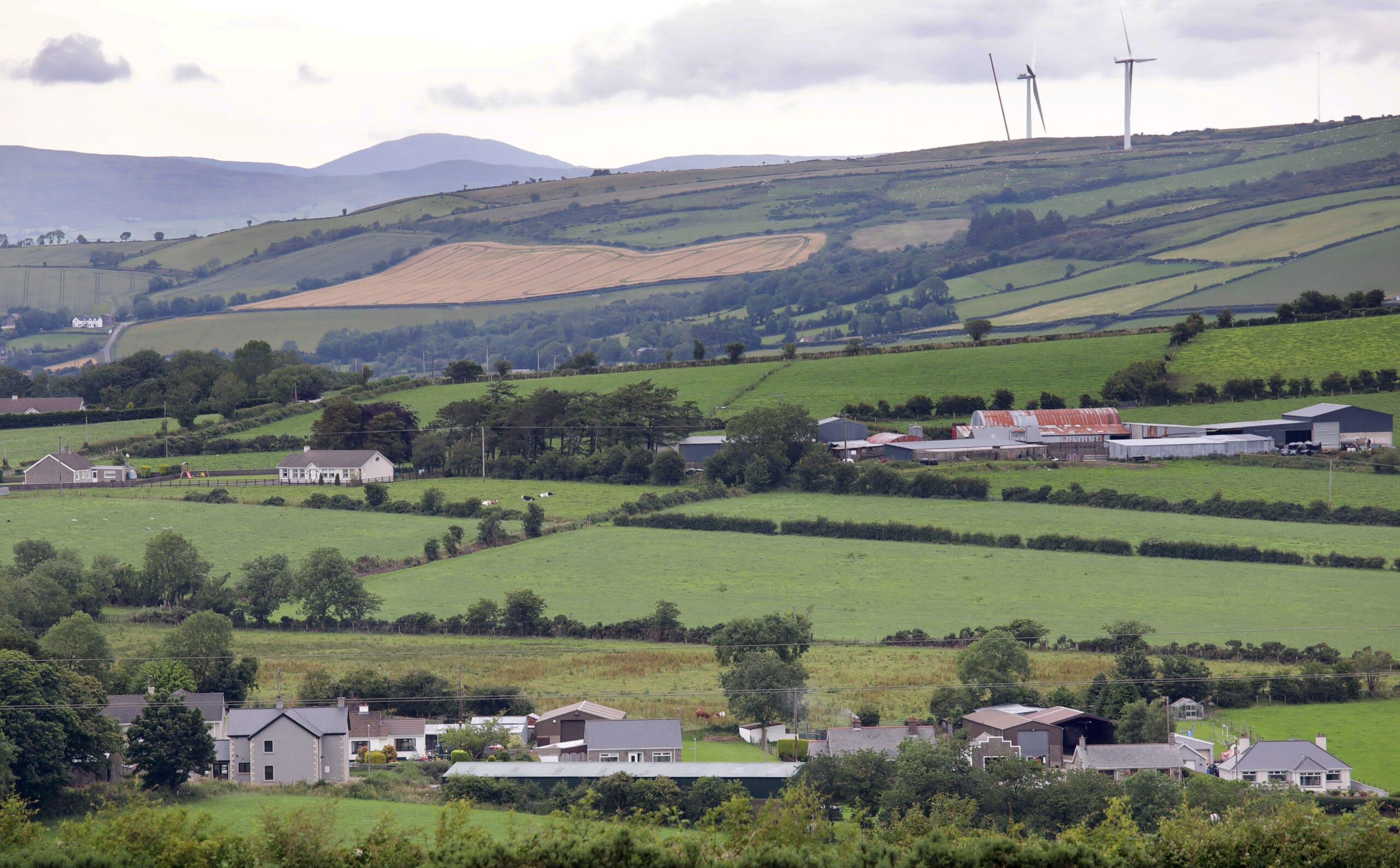
Tyrone countryside. Picture: Cliff Donaldson
UFU policy director blog, written by James McCluggage
There has been a lot of discussion in Northern Ireland in recent years around environmental regulation, water quality, ammonia, planning and the future direction of farm support. Much of that discussion has been difficult and at times deeply frustrating for farmers.
UFU members know better than anyone that the pressure on family farms is real. Costs remain high, margins are tight, labour is limited, and confidence can be fragile. When new policy proposals come forward, farmers are right to question what they mean in practice, how they will be paid for, and whether they are realistic on the ground. However, developments in the Netherlands are a timely reminder of why farmers must remain fully engaged in policy discussions, even when those discussions are uncomfortable.
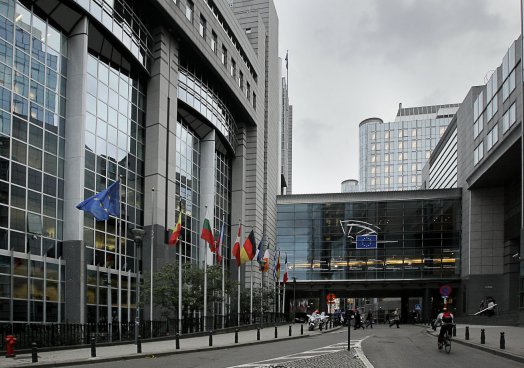
The Dutch cabinet has agreed on a major new €20 billion package aimed at reducing nitrogen pollution. The proposed measures are far-reaching. Farmers are being asked to cut ammonia emissions by 42–46% by 2035 compared with 2019 levels. Industry and transport will also be expected to halve nitrogen oxide emissions. The package includes proposed buffer zones around vulnerable nature areas, with 1,000-metre restriction zones around the 15 most heavily affected sites and 500-metre zones around a further 85 areas. Farms and businesses within these zones could be required to innovate, reduce livestock density, relocate, or stop farming altogether. A national limit of 2.6 cows per hectare on livestock farms by 2035 is also being proposed.
There is also the possibility of every livestock holding being placed under a binding emissions limit. If voluntary targets are not achieved, a mandatory mechanism could be triggered, leading to compulsory livestock reductions. These are not minor tweaks. They represent a fundamental intervention in the structure and operation of livestock farming. The Dutch situation has not appeared overnight. It follows a 2019 Council of State ruling which found that the government’s nitrogen strategy was in breach of EU nature protection requirements. Since then, successive governments have struggled to find a workable solution. Farming has been heavily affected, but so too has construction, with housing and infrastructure projects delayed because of nitrogen restrictions.
That is an important lesson. When environmental policy becomes gridlocked, it does not just create uncertainty for farmers. It can create uncertainty across the wider economy. But farmers are often the ones left carrying the greatest burden. Dutch farming representatives have made clear they are willing to play their part in reducing emissions. However, LTO Nederland has strongly criticised elements of the package, describing some of the choices as disproportionate. Their argument is one that will sound familiar to many UFU members: farmers cannot be held responsible for delivering all the targets if they are not given all the tools, support and flexibility needed to achieve them.
That is a message we must continue to press here in Northern Ireland. The UFU’s role is not to oppose change for the sake of it. Our role is to ensure that any change is fair, practical, properly funded and rooted in the reality of family farming. We must challenge bad policy, but we must also be at the table shaping better policy.
Northern Ireland is not the Netherlands. Our farming structure, land base, political context and agri-food supply chains are different. But there are clear warnings from the Dutch experience. If governments fail to work with farmers early, if targets are set without practical delivery routes, and if regulation races ahead of science, investment and support, the consequences can be severe with the Courts ultimately deciding the direction of travel. That is why UFU engagement on issues such as the Nutrients Action Programme, ammonia, planning, water quality and future farm support matters so much. It is not always easy. It is not always popular. But walking away would at best leave others to design the future of farming without farmers in the room and at worst see the Courts determine the outcome.
Members are right to expect the UFU to be firm. They are right to expect us to push back hard when proposals are unworkable. But we also must recognise that the direction of travel across Europe is clear. Environmental regulation is tightening, and farming will continue to face scrutiny. The challenge is to make sure Northern Ireland does not end up with blunt, damaging measures that undermine family farms, food production and rural communities.
The Dutch example shows just how serious things can become when policy, court rulings and environmental pressures collide. It should strengthen our resolve to fight for a better, more balanced way forward here. That means practical schemes, realistic timelines, proper funding, recognition of work already done, and policy that supports productive agriculture rather than forcing contraction by default.
There is still an opportunity in Northern Ireland to get this right. But that will only happen if farmers stay united, engaged and clear about what is needed.