
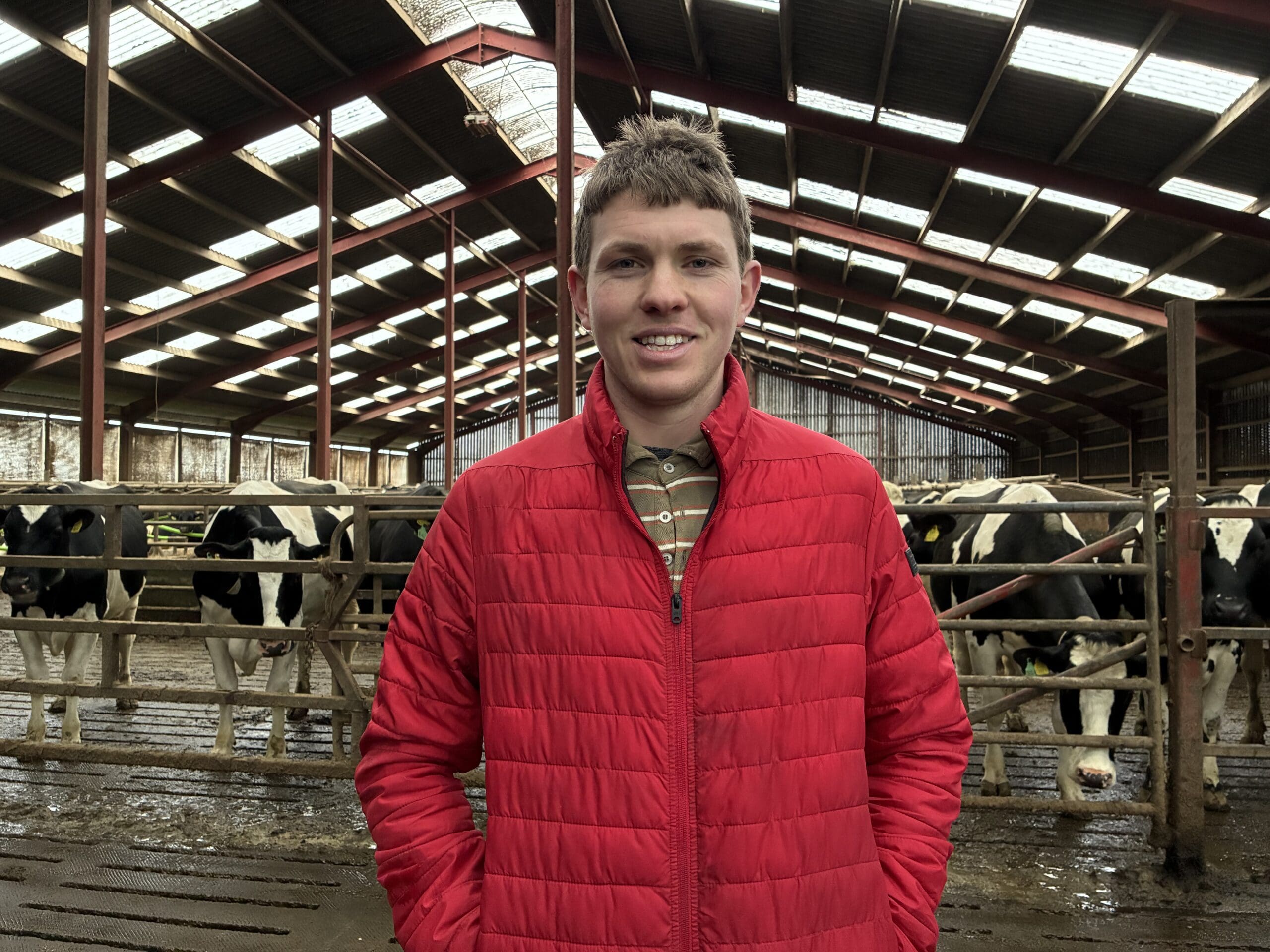
Above Greenisland, beneath the towering Knockagh Monument, 27-year-old Alexander Boyd balances two demanding roles. Alongside farming full-time with his father on their beef and sheep enterprise, Alexander has also carved out a niche as a part-time hoof trimmer, a profession few actively set out to pursue.
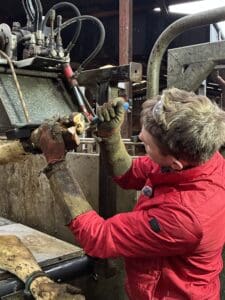
The Northern Ireland agri-food industry has created 113,000 jobs, based in both rural and urban areas according to statistics. As part of Februdairy, a campaign celebrating the dairy industry the Ulster Farmers’ Union spoke with Alexander in a bid to gain a better understanding of one quietly important job-role within the sector.
“It’s not a job where you wake up in the morning and think, I want to change my career to doing cows’ feet. It’s a very dirty job,” he says, acknowledging that while his clothes are clean for the interview, his usual attire is far muddier.
Despite the realities of the work, it is a role Alexander finds deeply rewarding.
“It’s a fulfilling job because you hopefully get to help cows improve their mobility and, generally, 90 percent of the time it pays off.”
FROM HELPING HAND TO HOOF TRIMMER
Alexander has been trimming cows’ feet for almost three years, formally starting in May 2023 after completing an Embryonics hoof trimming course in England with John Dawson, a prominent figure in cattle hoof trimming. However, his journey began well before that.
“I suppose my foot trimming experience really started back in 2019. My cousin Peter Boyd trimmed cows’ feet and I would have given him a hand a few days a week. That’s where I found the interest in it,” Alexander shared.
“I wasn’t doing any trimming as such back then. I was getting cows into the crush, fetching blocks and bandages, and generally giving a helping hand.”
Setting up independently required significant investment.
“£20,000 set me up with my crush and all my gear and got me on the road,” he shared.
CHALLENGES AND REWARDS
The most satisfying part of the role for Alexander is clear.
“I would say my favourite part of the role is the satisfaction of helping a cow that has been quite lame, that I have been able to treat and improve her mobility and overall well-being,” Alexander explained.
However, the job also comes with its challenges.
“The most difficult aspect of the role is cows that come in lame and you can’t necessarily find a problem. It could be stemming from their leg or their joints. Those are the cows that, unfortunately, you can’t really do much with. It’s more of a veterinary role to assist those cows.
“Sometimes you can get difficult cows that are flighty, but with a bit of gentle persuasion, they generally work with you.”
A GROWING INDUSTRY CONCERN
Lameness remains a significant issue within the dairy industry, according to Alexander.
“It’s estimated that lameness costs the UK dairy industry £250 million a year. These costs are incurred through drops in milk production, reduced fertility, and increased culling rates, all of which come at a cost to the dairy industry.”
Among the most common conditions he encounters in Northern Ireland is digital dermatitis, a bacterial infection that forms on the back of the cow’s hoof.
“It’s caused by an excess of muck or slurry and requires fast treatment because it can be very painful for the cow and can spread very rapidly throughout the whole house of cattle,” he explained.
Other issues, such as sole ulcers, are also common.
“This is really down to the environment the cow is in, her feeding regime, the sheds, and sometimes breeding itself.”
TRAINING AND STANDARDS
Alexander emphasised the importance of proper training.
“It’s important that you don’t just start doing cows’ feet without going through some sort of training. I completed a professional hoof trimming course but there are hoof trimming courses out there for farmers who don’t necessarily want to work to as high a level.”
Alexander was trained in the traditional five-step Dutch method, the approach most foot trimmers follow to maximise comfort for the animal.
“The first step is shortening the toes,” he explained.
“The length of the foot, or the front of the foot, should be 75 millimetres.
“The second step is balancing the soles to ensure there’s equal weight distribution.
“The third step is carving out the sites where sole ulcers may occur.
“That covers the first three steps of preventative trimming. If there’s a problem, that then needs to be treated. Steps four and five are related to that, and blocks or bandages are applied in these latter stages to treat the issue.”
The time required depends on whether the trimming is preventative or curative.
“For preventative trimming, the cow generally shouldn’t need too much. I just take the points off the toes, level the feet up, and carve out where sole ulcers may occur. I could do a cow in maybe five or six minutes,” he said.
“But with a lame cow, it really depends. It could take anywhere up to 10 minutes or so to do a cow. I prefer it to be as short a time as possible, so the cow is back out again into her familiar environment.”
DEMAND FOR THE TRADE
Alexander believes the future of hoof trimming in Northern Ireland is secure.
“I would say there’s a big demand in this country for hoof trimmers. Cows will always need their feet done and, with more farms adopting an indoor system, cows’ feet are exposed to more slurry and problems can arise.”
Despite the dirt and physical demands, pride remains at the heart of his work.
“Hoof trimming is a very satisfying job and I do take great pride in helping cows. Hopefully I’m able to let a cow out of the crush better off than the way she came in, and that’s a good feeling. I think everybody needs to take pride in their work and love what they do.”
Related Stories
UFU renew call for complete reversal of IHT changes as they enter force

Sustainability measures must work for farmers and reflect market demand