
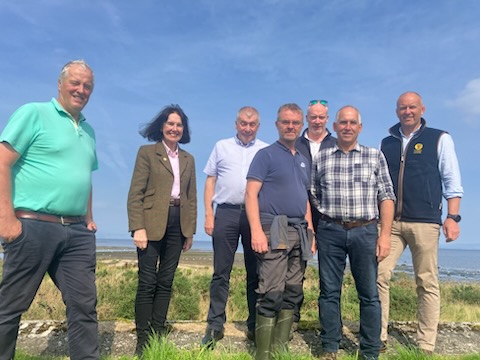
UFU deputy president, Clement Lynch, met with growers in the North West to discuss Farming with Nature mapping issues.
The Ulster Farmers’ Union has reiterated concerns regarding the Farming with Nature Transition Scheme after meeting arable growers in the North West who continue to report that significant areas of productive farmland have been deemed ineligible due to mapping constraints.
UFU deputy president Clement Lynch recently met affected growers to hear directly about the impact the issue is having on farm businesses and to gather further evidence from those affected.
Speaking after the meeting, Mr Lynch said, “The UFU has already formally raised concerns with DAERA regarding the treatment of some arable land within the Farming with Nature Transition Scheme. Meeting growers on the ground provided a valuable opportunity to better understand the practical implications for individual farm businesses and hear first-hand the frustrations being experienced.”
Farmers highlighted concerns that productive arable land, which was eligible for support under previous environmental schemes, is now being excluded from parts of the Farming with Nature Transition Scheme.
“Farmers are asking legitimate questions about why land that was previously eligible under environmental schemes is now being treated differently. They want clarity and certainty around the rules and how these decisions have been reached.”
The UFU has also been seeking clarification regarding the future of the pilot protein payment and how Farming with Nature options will apply to arable businesses.
Mr Lynch added, “It is important that DAERA fully understands the practical realities facing arable farmers and the contribution that productive arable land makes to both food production and environmental delivery. We have raised these concerns and will continue to engage constructively with the Department on behalf of our members.”
The UFU stressed that it will continue to represent the views of affected growers and seek clarification on the operation of the scheme, while recognising that decisions on eligibility and future scheme design rest with DAERA.