
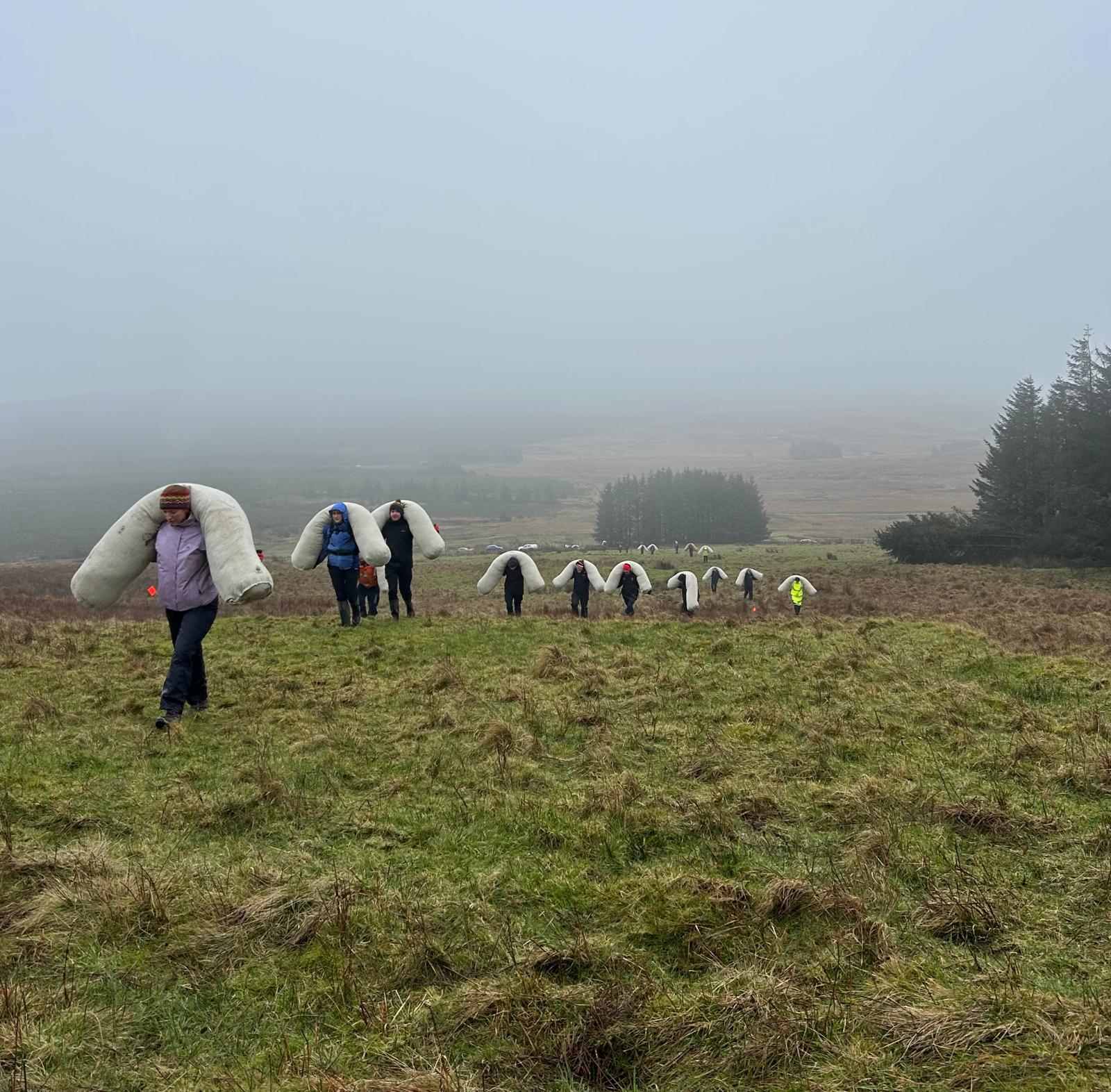
Volunteers carried 60 wool logs weighing 8kg onto site at Slievenanee Mountain
The Ulster Farmers’ Union (UFU) and Ulster Wildlife, working alongside Sustainable Rope Ltd, Ulster Wool and Ulster University, have launched an innovative peatland restoration trial using locally sourced wool on Slievenanee Mountain in the Antrim Hills.
The project involved the installation of 60 “wool logs” on areas of exposed and eroded blanket bog making it the largest trial of wool logs in Northern Ireland to date. Made from scoured fleece compacted into wool textile sacks, the logs are designed to slow water flow, trap sediment, and support the re-establishment of peat-forming vegetation such as sphagnum moss.
Wool as a material has already shown promising results in peatland trials in other parts of the UK, particularly in upland sites in Scotland and northern England, where it has been used to stabilise eroding peat and retain moisture.
The trial was carried out by local nature conservation charity Ulster Wildlife, with the support of around 30 volunteers who transported and installed the wool logs by hand across challenging terrain, reaching heights of over 500 meters above sea level.
Wool offers a potential alternative to imported coir, a natural fibre extracted from coconuts, often sourced from South-East Asia and commonly used in peatland restoration.
The initiative highlights the potential of natural, locally sourced materials in addressing environmental challenges, while also demonstrating the value of collaboration between farmers, environmental organisations and industry partners.
UFU Peatlands officer Stephanie Clokey said, “Wool is a natural, biodegradable material and is a logical solution for peatland management. Here we’re helping to rebuild damaged areas by using materials that work with the landscape, while supporting local farmers and adding value to something that has recently often been treated as a waste product rather than a resource, while creating new opportunities for what is often an underused by-product of farming”
The site at Slievenanee lies within the Antrim Hills Special Protection Area (SPA), an internationally important protected landscape designated for its upland bird populations and the habitats that support them. However, significant weathering and erosion over time have left areas of bare peat where vegetation has struggled to recover naturally. The introduction of wool logs aims to stabilise these areas and create conditions for peat-forming plants to return.
James Devenney, Peatland Restoration Manager at Ulster Wildlife, said, “Healthy peatlands are one of our most important natural assets. They store carbon, improve water quality, reduce flood risk and provide a home for specialist wildlife. When these habitats become damaged and eroded, restoring them is essential.
“We’re incredibly grateful to the farmers on Slievenanee Mountain, and the volunteers for their support in making this project happen. Early indications from the site are encouraging, and we’re excited to monitor how the wool logs perform over the coming months in slowing water movement, stabilising exposed peat and supporting vegetation recovery.”
A blended approach using both wool and coir may also be explored in future trials, combining the additional weight and durability of coir with the sustainability and local sourcing benefits of wool. Findings from the project will help determine whether wool logs could be adopted more widely in peatland restoration across Northern Ireland. The project demonstrates how practical, nature-based solutions can be implemented on the ground through partnership working, bringing together expertise from across agriculture, conservation and research.